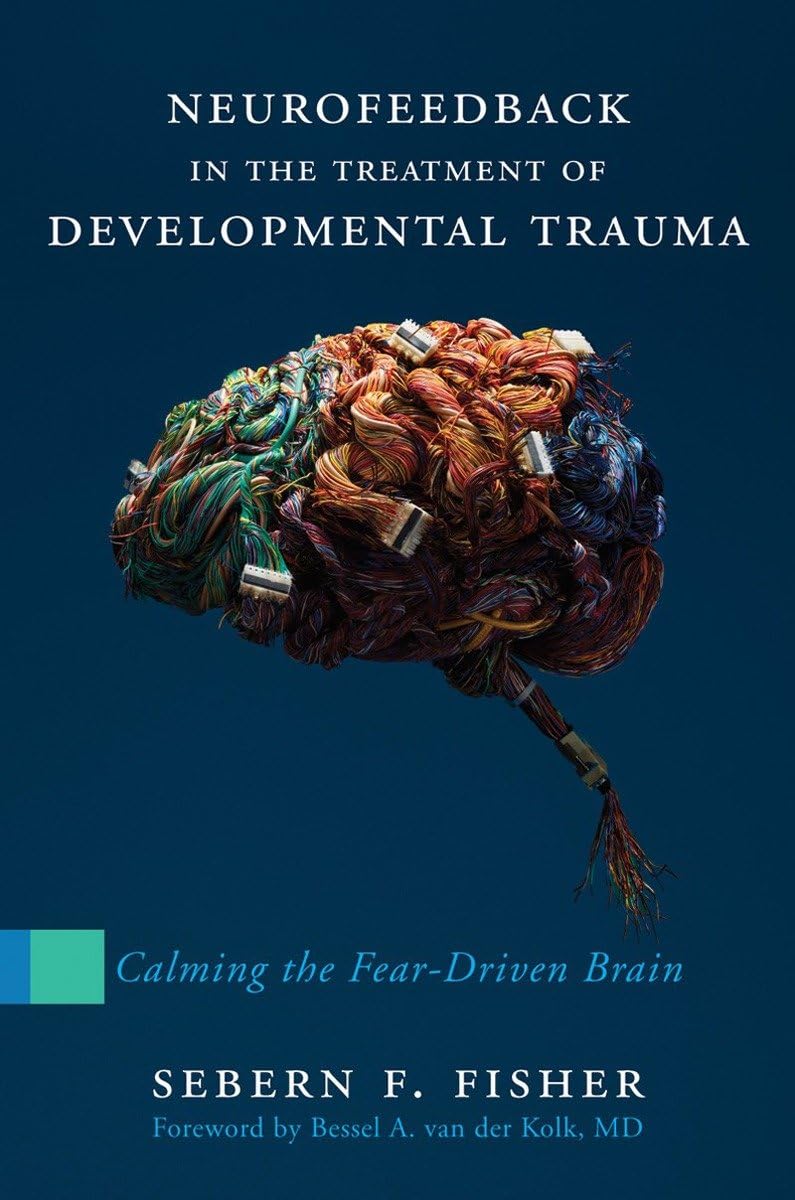
Neurofeedback in the Treatment of Developmental Trauma: Calming the Fear-Driven Brain: 9780393707861: Medicine & Health Science Books @ desertcart.com Review: insightful - I've read this book non-stop like a fiction, then opened it again to reread. I am hugely impressed with science behind the neurofeedback process, especially the impact of the early experience of motherlessness on the right hemisphere development. Both the separation and the bridge between mind and brain are insightful: "I could feel a new reality that my brain was separable from my mind, and that my mind was inseparable from my brain". As a therapist, I am trained to put emphasis on the mind. At the same time I see how beautifully the process of therapy is unfolding for those clients who combine neurotherapy with psychotherapy, so now I have a better understanding of what is going on inside the brain, the role of amygdala. It is going to change my practice. Love the stories of three clients with so serious disorders. Love the gentleness of therapy provided by dr Fisher, and her patience. I thought I would skip the stories, that they are tedious, but they were like magnets. The light writing style made all the science easy to understand. Protocol selection is more art than science, so I prefer training synchrony as overarching brain-wave organizing principle. However I am trying now FPO2 on myself. The last section about four patterns (that which cannot repeat itself and dies, that which repeats without change, that which repeats itself but changes, and that unfolding unpredictably, evolving) resonates with me profoundly. It's life propagation principle, the principle of creation, and I love, absolutely love that our brains are capable of overcoming the developmental trauma and evolve like beautiful, complex entities, the way Life created them. Review: The Medium is the Message - Sebern Fisher's writing embodies her message: the value of an integrated and well-regulated brain. She has attained the remarkable: a book that is at once informative and fascinating, scientific and warmly personal, academic and a page-turner for anyone interested in the subject. The clarity of her thinking, her ability to weave together strands of research, theory and practice and come up with a profoundly relevant tapestry, speaks to the coherence that neurofeedback is all about. What I found most unusual is the way she deftly bridges the divide between objectivity and personal point of view. Whereas my usual strategy for reading psychology is to jump around based on my interests and questions, relying heavily on the index, I found myself drawn into the narrative, which, due to her long-term and innovative quest for knowledge and her compassion for her patients, resonates on deeper levels than the purely academic. Her case histories are instructive, sometimes poignant, and gratefully, abbreviated to the point of relevance, thus avoiding the lengthy anecdotal chapters that bog down some books of its kind. I particularly appreciate her tolerance for (and willingness to confront) unanswered questions, which only adds gravitas to the research she provides. A seasoned expert in neurofeedback who is dedicated to the wellbeing of her clients, Ms. Fisher has written a landmark guide in this important and rapidly evolving field.
| Best Sellers Rank | #218,496 in Books ( See Top 100 in Books ) #46 in Neurology (Books) #309 in Popular Psychology Counseling #405 in Medical Counseling |
| Customer Reviews | 4.8 4.8 out of 5 stars (219) |
| Dimensions | 6.6 x 1.4 x 9.6 inches |
| Edition | Illustrated |
| ISBN-10 | 0393707865 |
| ISBN-13 | 978-0393707861 |
| Item Weight | 1.88 pounds |
| Language | English |
| Print length | 408 pages |
| Publication date | April 21, 2014 |
| Publisher | W. W. Norton & Company |
G**Z
insightful
I've read this book non-stop like a fiction, then opened it again to reread. I am hugely impressed with science behind the neurofeedback process, especially the impact of the early experience of motherlessness on the right hemisphere development. Both the separation and the bridge between mind and brain are insightful: "I could feel a new reality that my brain was separable from my mind, and that my mind was inseparable from my brain". As a therapist, I am trained to put emphasis on the mind. At the same time I see how beautifully the process of therapy is unfolding for those clients who combine neurotherapy with psychotherapy, so now I have a better understanding of what is going on inside the brain, the role of amygdala. It is going to change my practice. Love the stories of three clients with so serious disorders. Love the gentleness of therapy provided by dr Fisher, and her patience. I thought I would skip the stories, that they are tedious, but they were like magnets. The light writing style made all the science easy to understand. Protocol selection is more art than science, so I prefer training synchrony as overarching brain-wave organizing principle. However I am trying now FPO2 on myself. The last section about four patterns (that which cannot repeat itself and dies, that which repeats without change, that which repeats itself but changes, and that unfolding unpredictably, evolving) resonates with me profoundly. It's life propagation principle, the principle of creation, and I love, absolutely love that our brains are capable of overcoming the developmental trauma and evolve like beautiful, complex entities, the way Life created them.
C**D
The Medium is the Message
Sebern Fisher's writing embodies her message: the value of an integrated and well-regulated brain. She has attained the remarkable: a book that is at once informative and fascinating, scientific and warmly personal, academic and a page-turner for anyone interested in the subject. The clarity of her thinking, her ability to weave together strands of research, theory and practice and come up with a profoundly relevant tapestry, speaks to the coherence that neurofeedback is all about. What I found most unusual is the way she deftly bridges the divide between objectivity and personal point of view. Whereas my usual strategy for reading psychology is to jump around based on my interests and questions, relying heavily on the index, I found myself drawn into the narrative, which, due to her long-term and innovative quest for knowledge and her compassion for her patients, resonates on deeper levels than the purely academic. Her case histories are instructive, sometimes poignant, and gratefully, abbreviated to the point of relevance, thus avoiding the lengthy anecdotal chapters that bog down some books of its kind. I particularly appreciate her tolerance for (and willingness to confront) unanswered questions, which only adds gravitas to the research she provides. A seasoned expert in neurofeedback who is dedicated to the wellbeing of her clients, Ms. Fisher has written a landmark guide in this important and rapidly evolving field.
R**S
Excellent introduction to Neurofeedback
I bought this book based on having read "The Body Keeps the Score," which mentioned Sebern Fisher's work. I suffer from childhood developmental trauma and decided to get this as an intro to neurofeedback. I'm SO glad I did. It is an excellent guide that is written both for professionals who want to learn how to train patients, and for those of us who want to explore a new therapy option. I have hit a wall with talk therapy and neurofeedback seemed like something I was interested in exploring. Sebern thoroughly explains the process and the problems involved with treating developmental trauma disorders experienced in childhood. She takes an honest approach that basically says that neurofeedback is not a magic bullet, but proves that it is an exceptional way to treat those of us with these issues. It provides a lot of promise and proven results that she exhibits in the book. No doubt she has changed many lives, mine included. Because of this book I have made an appointment to begin my own neurofeedback therapy. If you are at all interested in a new form of therapy and have considered neurofeedack as an approach, I highly recommend this book to make your decision.
D**H
Paradigm Changing!
Reading this book has certainly had a profound effect on the way that I view the operation of the human mind and the possibilities that exist for effective treatment options in the remedy of attachment disorders and trauma. The book is well written and easy to read and follow and I recommend it highly to those interested in learning how to provide treatment using neurofeedback. It is a great introduction and practical resource.
M**A
Misleading
I thought this book was great when I first read it, until I tried neurofeedback years later. It was a huge mistake. You should do neurofeedback if you want your brain permanently and irreversibly damaged. I feel the same way about EMDR, which I have also tried. I am not the same… only 33 and ruined my life with both of these modalities. If a therapist claims that either of these therapies would benefit anyone, RUN. FAST.
M**V
Can We Actually Be Liberated From Excessive and Inappropriate Fear?
An excellent book by an outstanding neurofeedback therapist who has succeeded in accomplishing what had been previously thought to be impossible -- accessing the amygdala - the seat of inhibitory impulses driven by fearful impressions from the past, meant as a survival mechanism but too often functioning as an overly restrictive inhibitory mechanism which exerts its classic paralyzing effect on those who have gone through trauma. Sebern Fisher has found a way to liberate such people from restrictive encroachment of the amygdala on their lives through a neurofeedback process which she details in the book, leaving her patients happily musing "What am I going to do with the rest of my life now that it is no longer run by fear anymore?"
A**S
Aborda el Neurofeedback y su conocimiento en el trauma en el desarrollo, desde una perspectiva muy humana, a la vez que muy profesional
J**.
Läs om du jobbar inom psykiatrin, LSS, älskar Dr Bessel van der Kolks böcker, eller har cptsd el liknande
K**E
This is a fantastic book, especially if work with children with histories of developmental trauma.
L**A
Wonderful book. As an art therapist there are always questions that emerge about what works and for whom and Sebern F Fisher seems to have found a good dose of the magic elixir. Well written, great insights, well balanced approach, and a training I'd like to take if I were 30 years younger.
D**E
[(Neurofeedback in the Treatment of Developmental Trauma: Calming the Fear-driven Brain)] [Author: Sebern F. Fisher] published on (May, 2014) Sebern Fisher's description of the very complex art, and science, of Neurofeedback makes an interesting and rewarding read. It is a surprisingly easy read for such a technical subject - humanising technical neurofeedback techniques applied to stories of her client's unique problems. While she inspires us with stories of her successful experiences gathered over a decade and a half, Fisher displays unusual openness when describing her client's occasional negative fallout in response to an unsuitable approach. She shares the underlying issue for the fallout, and the shifts in neurofeedback focus to rectify the problem. This book focuses on using neurofeedback with people who experience some form of underlying developmental trauma. Fisher adopts a strong neuro-medical, 'deficit' lens that goes far beyond the scope of brain-based Neurocoaching, which has a more forward focused, 'positive lens' approach. The most useful take-away from this book is the simple yet comprehensive table in the appendix, directing neurofeedback to either the left or right hemisphere, or a combined left- right hemisphere workout.
Trustpilot
1 month ago
1 week ago


