

🔦 Illuminate your world with precision and speed!
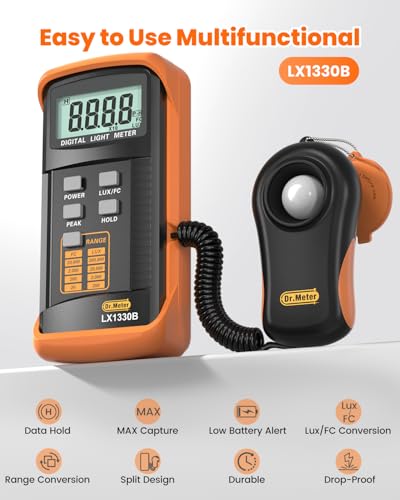
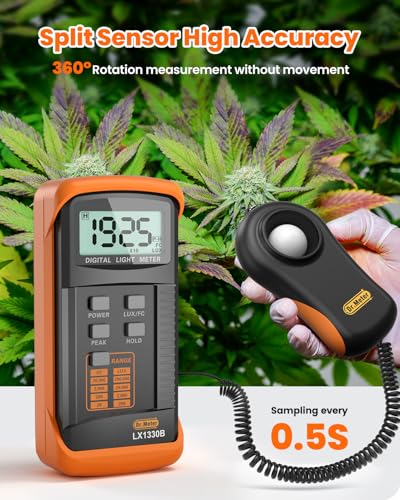
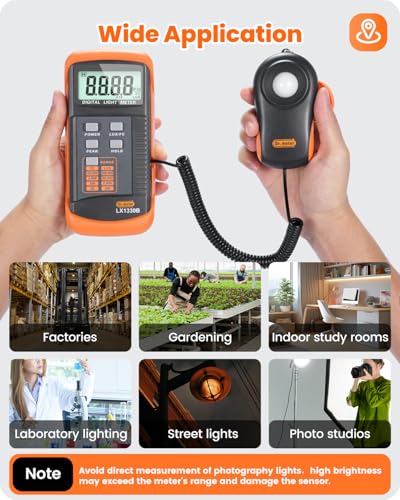
The LX1330B Digital Illuminance Light Meter by Dr.meter offers a broad 0-200,000 Lux measurement range with lightning-fast 2 readings per second. Featuring easy FC/LUX unit conversion, peak data locking, and a low battery alert, it’s designed for versatile use indoors and outdoors. Powered by an included 9V battery, this compact, ABS-built meter is ideal for professionals and plant enthusiasts seeking precise lighting data.


| ASIN | B005A0ETXY |
| Batteries | 1 9V batteries required. (included) |
| Batteries Included? | Yes |
| Batteries Required? | No |
| Battery Cell Type | Zinc Carbon |
| Best Sellers Rank | #2 in Photographic Light Meters |
| Customer Reviews | 4.5 4.5 out of 5 stars (3,092) |
| Date First Available | June 5, 2007 |
| Included Components | 1 x Light Meter |
| Is Discontinued By Manufacturer | No |
| Item Package Quantity | 1 |
| Item Weight | 12 ounces |
| Item model number | 1330B-V |
| Manufacturer | Dr.meter |
| Material | ABS |
| Measurement System | Metric |
| Part Number | 1330B-V |
| Power Source | Battery Powered |
| Product Dimensions | 4 x 1 x 8 inches |
| Style | Light Meter |
| Voltage | 9 Volts |
J**N
PERFECT! --- See within: LED lighting vs. LED grow lights.
This meter is excellent! It works perfectly and is superb. I purchased in 2017. After reading reviews from 2012 the supplier has upgraded based on feedback. Kudos!!! (Sensor cover and case clasps are two examples of fixes.) There is a lot of back and forth chatter in reviews and questions about whether this works for LEDs. They are missing the misunderstanding introduced by shorthand in the original question asked by some random closet grower. The answer to that: No, this is not a good tool to compare plant available light output between a new blue/red LED and an old HPS or MH full spectrum. At that task it will certainly fail. As it and any $5000 meter of this kind should. This is the wrong instrument. There is nothing special about LED light versus other types of light. It is all about the spectral response of the sensor head. The manual gives that response. I will try to add as a photo later. Overall a great sensor. Not only did it help me determine approximate light output if my home lettuce grow (yes, lettuce, not the other green) as one step to mitigate tip burn, but it also helped me identify some major problems with lighting setups at work.
C**S
Extremely Good Meter if used for what its suppose to!
Ok I will try to be as honest and precise as possible so that this review helps as many people as possible. I would like to start by saying that if you are a photographer and are looking for a light meter, please don't be cheap and look for something that is the right tool for your job! Now for those of us folks that want it for that basic and some not so complicated applications; If you are growing your own food indoors or any type of plant using lights this is perfect! Weather you are using LED's, CFL's, T5's, HPS, or MH this meter can really help you maximize the growth of your plants. All you need is know how to use it, but if you are like me and hate instructions or find them confusing there are many videos on Ytube that will brake it all down for you! See Simple :-) Now the case it comes with is kinda cheap and the latches that keeps it close kinda suck, but the meter will be protected in there just don's expect it to fall from the shelf and stay close. All and all for the price of this meter and the many benefits that you can get out of it its really the best bang for the buck. Hope this helps!
P**Y
Easy to use and accurate
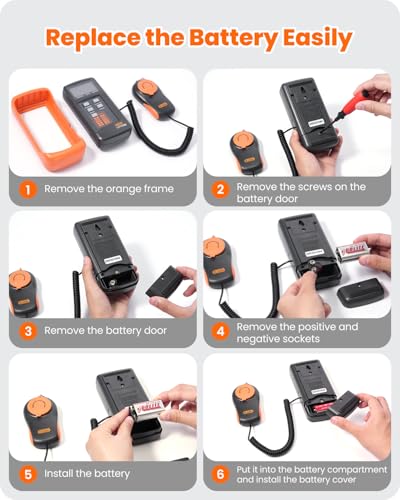
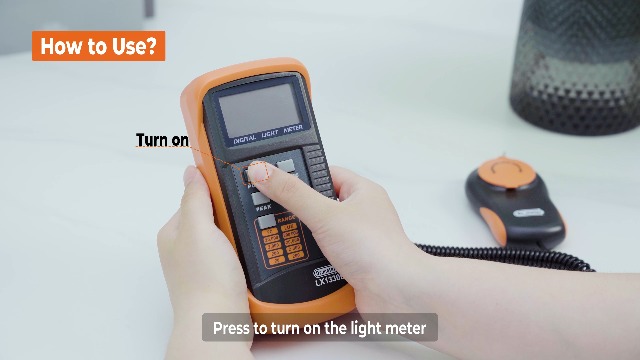
I'm a photographer and videographer and shoot in a studio with CFLs in softboxes. I wanted a method of quickly measuring the output of light heads and CFLs. And Dr.Meter seems to be just what the doctor ordered. BUILD quality is good: sturdy plastics, rubberized buttons and a thick rubber bumper. It feels solid and confident in hand. The LCD looks like something from the 1980s (no gray scale or color) and lacks a backlight. The light sensor is under a translucent dome and attached to a coiled cable hardwired to the device. It might be a little too easy to snag the cable on something and damage it. A plug-in/replaceable cable would be preferable. OPERATION: Peel off the rubber bumper, lift off the battery door and install a 9v battery (included). Squeeze the bumper back on and you're ready to rock. Hit power and point the dome at the light source. If it shows "1" on the LCD, that's Dr.Meter speak for "out of range." Press the range button to calibrate to a higher measure value. You have a choice of LUX or FC and can retain/stop metering by pressing the hold button. That's pretty much it. If you plan on comparing or recording a lot of data points, bring a pencil and paper. This is a barebones meter and has no data transmission or memory ability. One thing I learned after metering my lights is manufacturer specs for CFLs are totally whack. In other words, Dr.Meter confirms what my eyes suspected: some 60W bulbs are brighter than 105W bulbs! So I need to balance lights by actual light output and not according to manufacturer specs. The other useful thing about this meter is I can record output of each light head from the subject's position, write it down, and precisely recreate the light balance of the set at a later date. FINAL BLURB: All in a great meter for measuring light levels in studios, offices, stage sets and homes: easy to use, accurate and priced reasonably.
R**T
a worthy meter
I recently received the Mastech meter to monitor the lighting in my nursery. I found it easy to use although the directions might be a bit improved. For instance, putting in the supplied battery it's necessary to remove the rubber casing. The instructions said to slide off the battery cover in the direction of the arrow but there was no arrow and the cover wouldn't securely fit unless the rubber case was on. It took a little practice to figure out the scales since pushing the range button wasn't simply reflected on the LCD, especially on the lower ranges (afterwords it would show 10x,100x, etc.)It would have been nicer had it shown the actual amount on the readout within a particular range rather than having to multiply it by one of the factors. I should emphasize that the above quibbles are very minor and that the meter performs it's functions very well. The meter is well built and the rubber casing and sensor cover afford it excellent protection. Both the sensor and main unit are light weight and easy to grip. The readings I got were consistent time after time.I think that for the money it's an excellent buy and superior to most others on the market in its price range or even some higher priced ones. I would recommend this meter for anyone who wants a reliable meter that covers a great range and is very affordable.
P**L
Great value and accurate
I**G
Working properly, I get reasonable readings for the light intensity.
F**E
Utile pour mesurer l'éclairage dans les parties communes d'un immeuble ,où des normes d'intensité lumineuses doivent être respectées en fonction de dispositions légales. Instrument utile pour Syndic d'immeuble. J'ai regretté que le mode d'emploi n'explique pas comment mettre les piles: j'ai mis tout un temps avant de comprendre qu'il fallait au préalable retirer la protection périphérique en caoutchouc orange et seulement ensuite dévisser le couvercle du compartiment piles, en partie inférieure du dos de l'appareil.
M**I
Practical, easy handling, accurate
E**D
perfect for adjusting lighting distance, works on all light types, just be aware that it only measures visible light!!! it doesn't measure light humans can't see (PAR values with UV and IR) most LEDs have IR & UV also so they would not be included in the lux amount the plant actually gets, but still quite useful (would just be a little more lux IE: if aiming for 75k lux. maybe set your LED setup at 65-70k on the meter just to be safe
Trustpilot
2 months ago
3 days ago


